Clinical Pilot
An invitation for LGBTQ+-affirming clinicians

Unbroken Pride Clinical Pilot
Unbroken Pride is inviting LGBTQIA+-affirming clinical providers across the United States, Canada, Australia, New Zealand, United Kingdom and Europe to take part in a practice-based pilot exploring how the series can be used as an optional companion alongside therapy.
What Unbroken Pride is
Unbroken Pride is a survivor-led, identity-specific self-help series created for LGBTQIA+ adults navigating the lasting impacts of childhood harm, family rejection, and minority stress.
The series includes dedicated editions for Lesbian, Gay, Bi, Trans, and Queer readers. Each edition offers practical tools for safety and grounding, emotional regulation, cognitive reframing, narrative reflection, pride-based self-reclamation, and relational boundaries.
It is designed for self-paced use, independently or as an optional companion alongside affirming professional support.
Unbroken Pride is not a therapy protocol, manualised treatment model, crisis intervention tool, or substitute for clinical care. It is a psychoeducational and reflective resource intended to support identity-affirming work without asking people to leave parts of themselves outside the process.
Why this pilot exists
Many LGBTQIA+ clients arrive in therapy carrying experiences that mainstream self-help resources only partially address.
Family rejection, identity-based shame, and minority stress often shape the work, yet many recovery tools still treat these as secondary. Clients are left translating their lives into frameworks that were never designed around their experience.
Unbroken Pride was created to reduce that gap.
This pilot explores how the resource functions in real clinical contexts.
Pilot goals
The Unbroken Pride Clinical Pilot aims to:
- Understand clinical usefulness – Explore how affirming clinicians use the series as a between-session companion, psychoeducation support, or structured self-guided resource for LGBTQIA+ adult clients.
- Assess fit for identity-specific work – Gather feedback on how well each edition supports clients navigating family rejection, minority stress, identity-based shame, and related developmental harm.
- Identify strengths and limits – Learn where the materials support therapeutic work well, and where they need refinement for clarity, pacing, accessibility, or clinical practicality.
- Improve clinician guidance – Strengthen clinician-facing notes, suggested use cases, and adaptation guidance so the series is easier to integrate ethically and flexibly into affirming practice.
- Centre lived experience – Unbroken Pride is a self-help companion, not a therapy protocol, treatment manual, or replacement for clinical care.
- Inform future development – Use pilot feedback to refine language, structure, companion resources, and implementation supports across the series.
Who the pilot is for
We welcome expressions of interest from:
- LGBTQIA+-affirming psychologists
- counsellors and psychotherapists
- social workers
- mental health clinicians
- trauma-informed practitioners
- clinicians working with LGBTQ adult clients
Especially those supporting clients affected by:
- family rejection or identity-based harm
- minority stress
- complex trauma / developmental trauma histories
- internalised queerphobia, homophobia, biphobia, lesbophobia, or transphobia
Clinicians working with neurodivergent LGBTQIA+ clients are also encouraged to take part, particularly in relation to the Neuroqueer Companion as it becomes available.
What participation may involve
Participation is designed to be flexible and low-burden. Clinicians may:
- review one or more editions
- use selected tools or chapters with suitable clients where clinically appropriate
- provide structured feedback on usability, language, pacing, and clinical fit
- note how clients respond to identity-specific framing
- share reflections on integration with existing therapeutic work
Client use should always remain clinically judged, optional, and paced according to the client’s needs and safety.
No clinician is expected to use the full series, adopt it as a protocol, or change their therapeutic modality.
How the pilot works
Participation follows a clear, low-burden process:
- Express interest by email
- Receive the Pilot Overview and Clinician Participation Agreement
- Confirm the agreement
- Receive access to the relevant edition(s) and clinician guidance materials
- Review the materials and, if appropriate, use selected parts with clients
- Share de-identified feedback
The pilot runs asynchronously by email.
Video or face-to-face meetings are not part of the pilot process.
Full resource access is provided only after the Clinician Participation Agreement is confirmed.
Important boundaries
Unbroken Pride is:
- a self-help / psychoeducational companion
- suitable for personal use or adjunctive clinical support
- identity-affirming and survivor-led
Unbroken Pride is not:
- a branded therapy model
- a manualised treatment protocol
- a crisis intervention tool
- a substitute for assessment, formulation, or professional care
Additional pilot boundaries:
- Full resource access is provided only after the Clinician Participation Agreement is confirmed
- Feedback must be de-identified only
- No identifiable client information should be shared with Unbroken Pride
- Unbroken Pride does not enter a treating relationship with clients
- Clinicians remain fully responsible for client suitability, informed consent, pacing, risk management, integration with their own modality, and duty of care
What clinicians receive
After the Clinician Participation Agreement is confirmed, pilot participants may receive:
- Complimentary access to selected Unbroken Pride editions
- Clinician-facing guidance notes
- A clear feedback framework
- The opportunity to contribute practical feedback that informs refinement of the series
- Optional acknowledgement in future pilot summary materials, if desired
Invitation to join
If you are an LGBTQIA+-affirming clinician interested in exploring identity-specific, pride-centred self-help resources with your clients, we would value your involvement.
We are particularly interested in practitioners who:
- Want better adjunctive tools for LGBTQIA+ adult clients
- Work regularly with family rejection and minority stress
- Value survivor-led, non-pathologising resources
- Are willing to share practical, honest feedback
Express your interest
Email: hello@unbrokenpride.com
Please include:
- your name
- professional role / modality
- location
- primary client populations
- which edition(s) you are most interested in reviewing
Identity is not the problem.
“I needed something that didn’t ask people to leave parts of themselves outside the process.”
JOEY PRISM, creator of Unbroken Pride
Pilot FAQ for Clinicians
No. It is a survivor-led self-help and psychoeducational companion. It is not a manualised therapy model and should not be used as a replacement for assessment, formulation, or clinical care.

As seen in
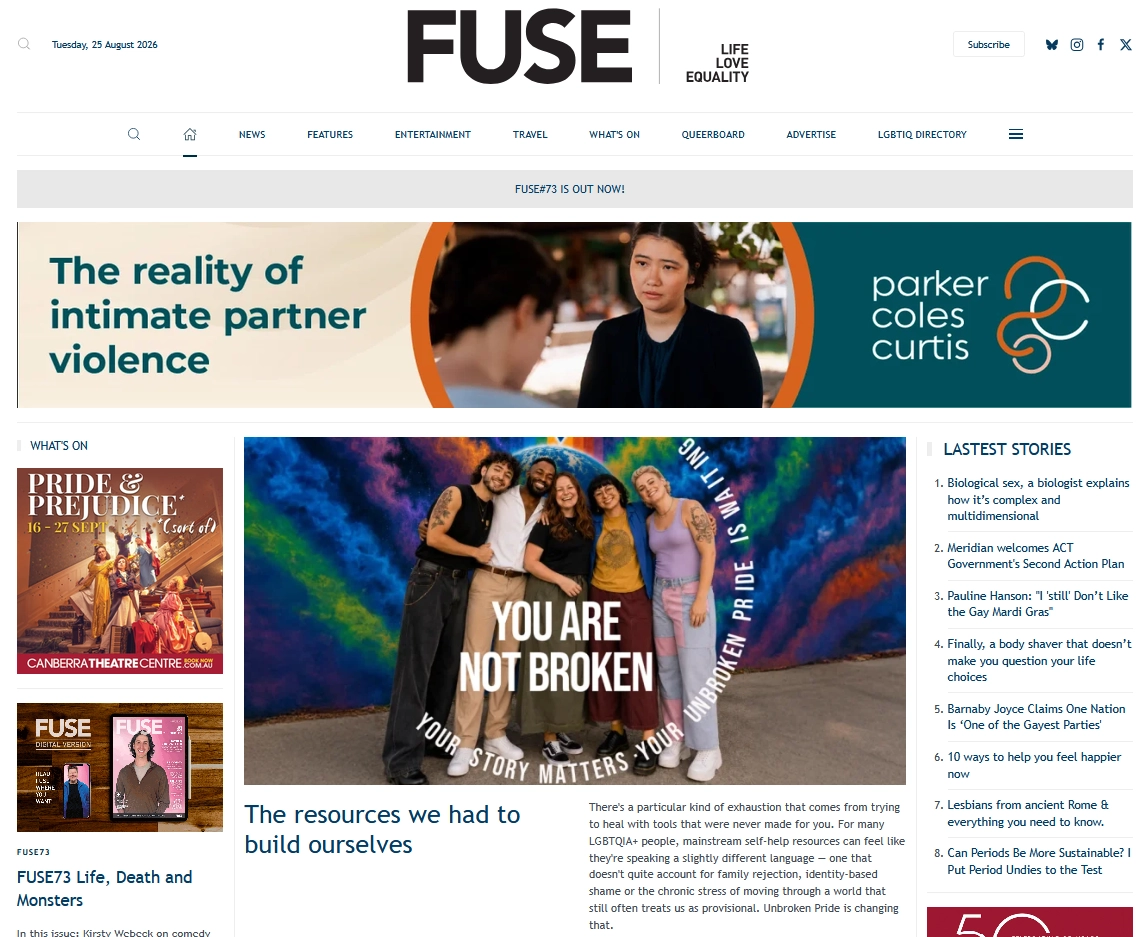
Homepage feature published 25/08/2026 with Fab Things category article "The resources we had to build ourselves"

Unbroken Pride
Shop the Series